
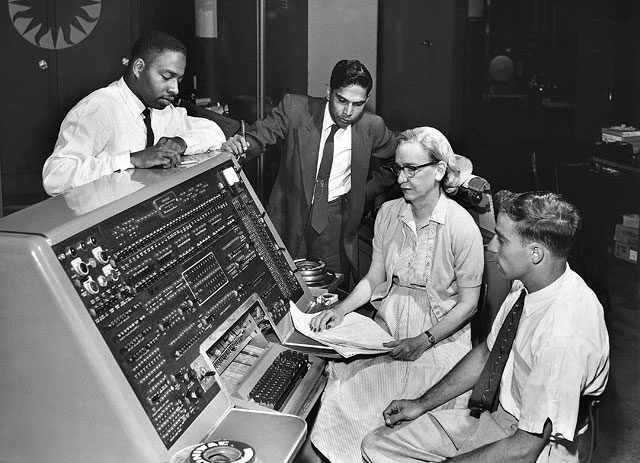




Grace Hopper, 1952.
flickr.com | cc 2.0 ↗
Grace Hopper is considered the mother of computer programming. She is the woman whose contributions laid the foundation for the modern digital age.
Born in the early 20th century, Grace Hopper was ahead of her time. She earned a doctorate in mathematics from Yale University in 1934, a remarkable achievement considering the role of women at the time.
During World War II, Hopper left her academic career and joined the U.S. Navy, where her path in computing began to take shape.
While serving in the Navy, she was sent to Harvard University, where she worked on the Mark I, the first large-scale computer in the United States. Enchanted by the machine, Hopper not only operated the Mark I during the war but also actively participated in the development of technologies that would be fundamental to the future of computer programming.
After the war, Hopper invented the first compiler, a program that translates instructions written in human language into machine code, thus facilitating computer programming. This innovation led to the development of the Common Business-Oriented Language (COBOL), which revolutionized business data processing and is still used today.
In addition to her technical achievements, Grace Hopper is also known for identifying the first literal computer “bug”—a moth that caused the Mark II to malfunction. This gave rise to the term “debugging” for the process of finding and fixing software bugs.
Grace Hopper retired from the Navy as a rear admiral, the most senior officer at the time of her retirement. She continued to influence the field of computer science through lectures, consulting, and participation in educational programs until her death in 1992.
Grace left a lasting legacy not only as a technological pioneer but also as an inspiring example of perseverance and innovation. Her story is a powerful reminder of the vital contribution of women in science and technology, often underestimated throughout history.
© T2M 2023-2025 | All rights reserved
T2M – Test to Market
Acreditamos firmemente que a Internet deve estar disponível e acessível a qualquer pessoa e estamos comprometidos em fornecer um site acessível ao público mais amplo possível, independentemente das circunstâncias e habilidades.
Para cumprir isso, pretendemos aderir o mais estritamente possível às Diretrizes de Acessibilidade de Conteúdo da Web 2.1 (WCAG 2.1) do World Wide Web Consortium (W3C) no nível AA. Essas diretrizes explicam como tornar o conteúdo da Web acessível a pessoas com uma ampla variedade de deficiências. O cumprimento dessas diretrizes nos ajuda a garantir que o site seja acessível a todas as pessoas: cegos, deficientes motores, deficientes visuais, deficientes cognitivos e muito mais.
Este site utiliza várias tecnologias destinadas a torná-lo o mais acessível possível em todos os momentos. Utilizamos uma interface de acessibilidade que permite que pessoas com deficiências específicas ajustem a interface do usuário do site (interface do usuário) e o projetem de acordo com suas necessidades pessoais.
Além disso, o site utiliza um aplicativo baseado em IA que é executado em segundo plano e otimiza seu nível de acessibilidade constantemente. Este aplicativo corrige o HTML do site, adapta sua funcionalidade e comportamento para leitores de tela usados por usuários cegos e para funções de teclado usadas por pessoas com deficiência motora.
Se você encontrou um defeito ou tem ideias para melhorias, ficaremos felizes em ouvi-lo. Você pode entrar em contato com os operadores do site usando o seguinte e-mail: wp.t2m@t2mlab.com
Nosso site implementa a técnica de atributos ARIA (Accessible Rich Internet Applications), juntamente com várias mudanças comportamentais diferentes, para garantir que os usuários cegos que visitam com leitores de tela possam ler, compreender e aproveitar as funções do site. Assim que um usuário com um leitor de tela entra em seu site, ele imediatamente recebe uma solicitação para inserir o perfil do leitor de tela para que possa navegar e operar seu site com eficiência. Veja como nosso site cobre alguns dos requisitos mais importantes do leitor de tela, juntamente com capturas de tela do console de exemplos de código:
Otimização do leitor de tela:
executamos um processo em segundo plano que aprende os componentes do site de cima para baixo, para garantir a conformidade contínua, mesmo ao atualizar o site. Nesse processo, fornecemos aos leitores de tela dados significativos usando o conjunto de atributos ARIA. Por exemplo, fornecemos rótulos de formulário precisos; descrições de ícones acionáveis (ícones de mídia social, ícones de pesquisa, ícones de carrinho, etc.); orientação de validação para entradas de formulário; papéis de elementos como botões, menus, diálogos modais (pop-ups) e outros. Além disso, o processo em segundo plano verifica todas as imagens do site e fornece uma descrição precisa e significativa baseada em reconhecimento de objeto de imagem como uma tag ALT (texto alternativo) para imagens que não são descritas. Ele também irá extrair textos que estão embutidos na imagem, usando uma tecnologia OCR (reconhecimento óptico de caracteres). Para ativar os ajustes do leitor de tela a qualquer momento, os usuários precisam apenas pressionar a combinação de teclado Alt+1. Os usuários de leitores de tela também recebem anúncios automáticos para ativar o modo de leitor de tela assim que entram no site.
Esses ajustes são compatíveis com todos os leitores de tela populares, incluindo JAWS e NVDA.
Otimização da navegação do teclado: O processo em segundo plano também ajusta o HTML do site e adiciona vários comportamentos usando o código JavaScript para tornar o site operável pelo teclado. Isso inclui a capacidade de navegar no site usando as teclas Tab e Shift+Tab, operar menus suspensos com as teclas de seta, fechá-los com Esc, acionar botões e links usando a tecla Enter, navegar entre elementos de rádio e caixa de seleção usando as teclas de seta e preencha-os com a barra de espaço ou a tecla Enter. Além disso, os usuários de teclado encontrarão menus de navegação rápida e salto de conteúdo, disponíveis a qualquer momento clicando em Alt+1 ou como os primeiros elementos do site ao navegar com o teclado. O processo em segundo plano também lida com pop-ups acionados movendo o foco do teclado em direção a eles assim que eles aparecem e não permite que o foco se desvie para fora dele.
Os usuários também podem usar atalhos como “M” (menus), “H” (títulos), “F” (formulários), “B” (botões) e “G” (gráficos) para pular para elementos específicos.
Nosso objetivo é oferecer suporte à maior variedade possível de navegadores e tecnologias assistivas, para que nossos usuários possam escolher as ferramentas que melhor se adaptam a eles, com o mínimo de limitações possível. Portanto, trabalhamos muito para poder oferecer suporte a todos os principais sistemas que compreendem mais de 95% da participação no mercado de usuários, incluindo Google Chrome, Mozilla Firefox, Apple Safari, Opera e Microsoft Edge, JAWS e NVDA (leitores de tela), ambos para Windows e para usuários de MAC.
Apesar dos nossos melhores esforços para permitir que qualquer pessoa ajuste o site às suas necessidades, ainda pode haver páginas ou seções que não sejam totalmente acessíveis, estejam em processo de acessibilidade ou careçam de uma solução tecnológica adequada para torná-las acessíveis. Ainda assim, estamos melhorando continuamente nossa acessibilidade, adicionando, atualizando e aprimorando suas opções e recursos, desenvolvendo e adotando novas tecnologias. Tudo isso para atingir o nível ideal de acessibilidade, acompanhando os avanços tecnológicos. Para qualquer ajuda, entre em contato com: wp.t2m@t2mlab.com