
Greenwashing vs. Sustainable Development:
The Truth Behind Sustainability Practices.
- Miscellaneous
- Equipe Editorial

Marcos Felipe Magalhães, PhD in Social Sciences from COPPE UFRJ, Postdoctoral Fellow in Economics from IE UFRJ, and currently a Postdoctoral Fellow in Systems Engineering at UFRJ, is a renowned expert in planning, management, and sustainable development. With extensive experience, including serving as General Director of Coca-Cola Brazil, and authoring several books on the subject, he is a leading figure in the field of corporate sustainability.
From greenwashing to legitimate Sustainable Development
It is not enough to make noble Mission or Purpose statements in organizations, but rather to act towards the results that are in the company’s systems, processes and daily practices, requiring a deep intellectual and emotional understanding from the point of view of the sustainability of the production resources of the Earth, Society, Capital and Labor.
Sustainability as a competitive advantage, in the sense of its longevity, depends on sustainable businesses, solutions and attitudes in the expectation of a more economically prosperous world, as well as an environmentally and socially fairer one.
Aiming to fulfill the Organization’s Purpose without appropriate action is mere daydreaming. And acting without effort is an exercise in meditation. Therefore, since every discourse must be translated into practice, and since there is no practice without effort, the only way to validate the execution of the strategy is through commitment and monitoring of legitimately sustainable results.
On the other hand, while there is a concern with practices that generate sustainable results, contrary to good objectives, there appears the reprehensible greenwashing, an expression in which brands create a false appearance of sustainability, and that the products, objectives and policies are environmentally friendly, without necessarily applying it in practice.
In the cursed category of deceiving stakeholders, we can include socialwashing, which repeats the “washing” mechanism to avoid demanding greater social responsibility from companies, often taking specific actions, but without a more effective and continued commitment to playing an active role in overcoming social inequalities and exclusions. And since social impact metrics are less frequent than those that guide environmental initiatives, it is more difficult to identify actions that are mere makeup (i).
Some subgroups of socialwashing (ii) are “bluewashing” (visual association with the UN to give undue legitimacy), “pinkwashing” (ineffective association with themes linked to LGBTQI+ agendas), and “rainbowashing” (inappropriate use of the UN Sustainable Development Goals).
The concept of washing, laundering or ideological falsehood, can occur in the governance dimensions, when “creative accounting” reaches the limits of accounting fraud, or also in the People dimension, when the exploitation of labor abuses the asymmetry of power between contractors and employees.
And it’s not too much to admit the existence of peoplewashing in organizations that implement relaxation spaces but maintain a culture that doesn’t allow people to use them, or that talk about diversity practices but don’t have an inclusive and diverse environment.
Peoplewashing is a culture that validates behaviors that its strategies don’t advocate, leaders who only think about results and ignore people, pay unhealthy pay instead of improving the work environment, and measure downtime due to accidents instead of measuring employee safety. Organizations truly dedicated to People Satisfaction leverage modern technologies so they can truly harness people’s skills, imagination, dreams, and ideas.
Companies that intentionally adopt whitewashing strategies often do so to distance themselves from environmental or social lapses of themselves or their suppliers (iii), making the practice contribute to damaging the organization’s relationships with Stakeholders, undermining the necessary relationship of trust in the system, and diminishing the power of the Parties to lead companies to more sustainable manufacturing processes and business operations (iv).
When a company decides to behave responsibly and adopt a sustainable development vision, it may have to profoundly change its corporate culture to understand and embrace the concept. Integrating sustainable development into communications is not enough to persuade stakeholders to support the organization’s strategic plan (v). An organization truly committed to sustainable development requires that responsibility for the issue is not diffuse or non-strategic, that there is C-level engagement, that there is a connection with the core business, and that its actions are not circumstantial or opportunistic.
The term sustainability is widely used to indicate programs, initiatives and actions aimed at preserving production resources, but in fact it refers to the organization’s commitments in four distinct areas: Environmental, Social, Governance and People, which are the pillars of Sustainable Development.
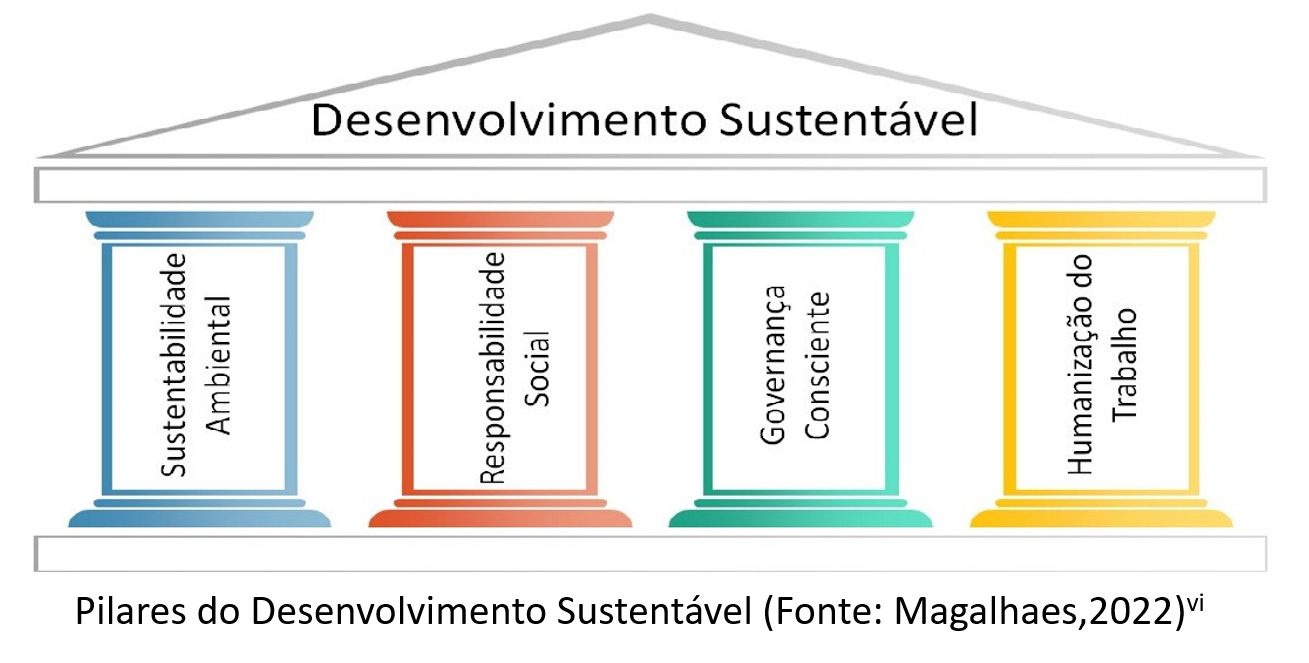
Each of the pillars of Sustainable Development is equally important, since
the sustainability of the whole depends on the sustainability of each of its parts. In other words, a business that wants to be sustainable seeks to integrate all four pillars, and to achieve this goal, each pillar must be treated equally.
The Sustainable Development proposal offers an approach that aims to explore the dimensions of the four pillars, in which the concepts of value are decoupled from the profit/loss equation and are viewed from the perspective of service, achieving the priority objectives of each Stakeholder. The logic, then, implies an interrelated set of trends and forces that affect all environmental, social, governance, and human activities.
Using this model, it becomes a management exercise to understand how companies can incorporate all four pillars of sustainability into their core activities. The answer lies in the breakdown of the Sustainable Development Matrix into a set of stakeholder commitments based on ESG+P criteria — Environment, Society, Governance, and People.
The Sustainable Development Matrix, inspired by these concepts and adding considerations of individual and humanized interest, aims to recognize the efforts of organizations to reward the Environment, Society, Governance and People, allowing them to visualize, with their own criteria, whether the practices are in line with the organization’s discourse, and to produce rewards in the ESG+P dimensions (Environment, Society, Governance and People), in such a way that the resources obtained are sufficient to keep their organisms alive and generate growth and value.
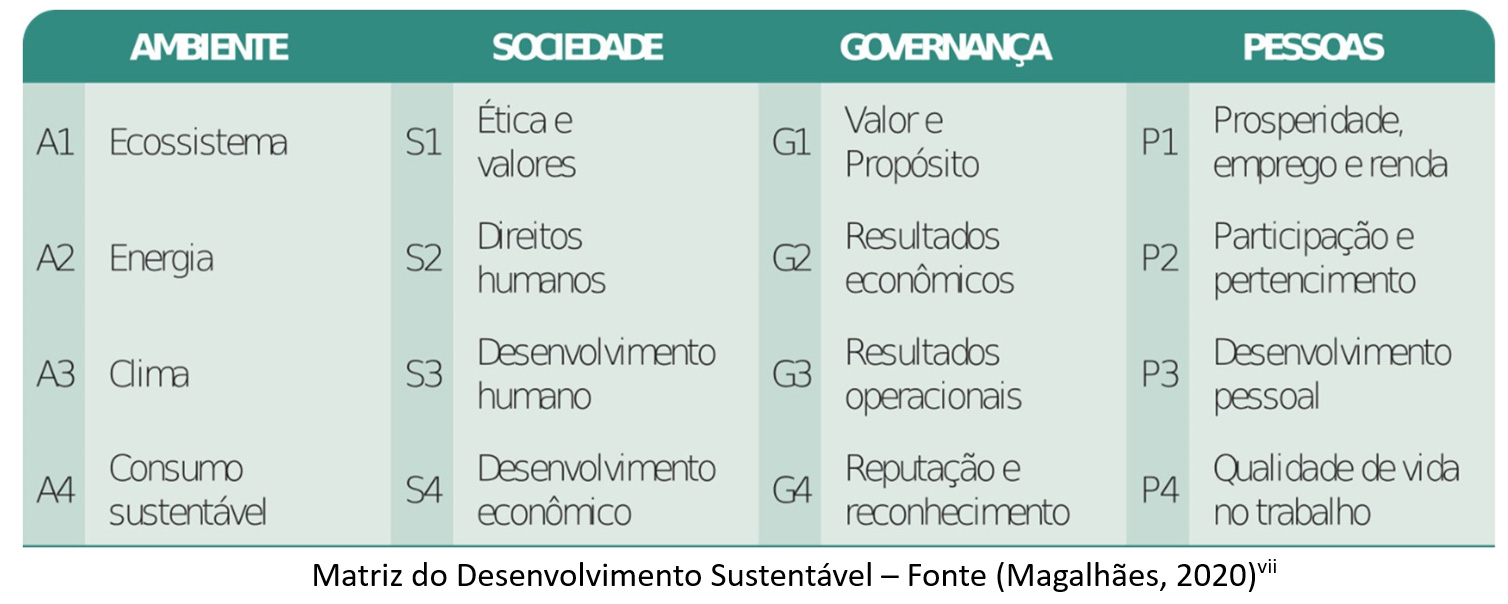
In summary, the following are the commitments that organizations must assume in the form of sustainable practices, according to the nature of their business.
ENVIRONMENT
E1 – Advocate for environmental sustainability and implement policies and practices to protect natural ecosystems.
E2 – Seek to increase energy efficiency throughout the value chain
E3 – Substantial reduction in emissions associated with our own operations and those of the supply chain.
E4 – Technology for product development, green inputs, biodegradable packaging, circular economy and selective collections.
SOCIETY
S1 – Respect the culture, values, moral and ethical principles, legality and order in the
Societies in which the organization operates
S2 – Contribute to the principles of the Universal Declaration of Human Rights, in defense of the basic rights for a dignified life, with freedom, health and security of people
S3 – Contribute to improving the HDI through specific actions aimed at
Education, Health and Sanitation, community causes and social programs, tourism, sports and leisure
S4 – Exercise Corporate Social Responsibility, contributing to the improvement of infrastructure, driving progress and competitiveness of the System
GOVERNANCE
G1 – Organizational sustainability generating value through evidence of growth, responsibility and sustainability
G2 – Wealth generation and profitability of total assets, and effective business management. Ensure compliance with fiscal targets and the proper allocation of public funds.
G3 – Work for results that reflect the efficiency of the operational management process and excellence in the use of resources within the autonomy of managers
G4 – Institutionally improve the organization, reinforcing its legitimacy, prestige, reputation and other intangibles, as assessed by customers, suppliers, partners and Society
PEOPLE
P1 – Social development for job creation, employment, and income. Support for entrepreneurship and encouragement of formal employment.
P2 – Share the organization’s success and opportunities for inclusion and diversity without limitations of any kind
P3 – Education and training to promote the personal and professional development of individuals
P4 – Offer quality of life at work, safety and organizational climate and social assistance to the workforce
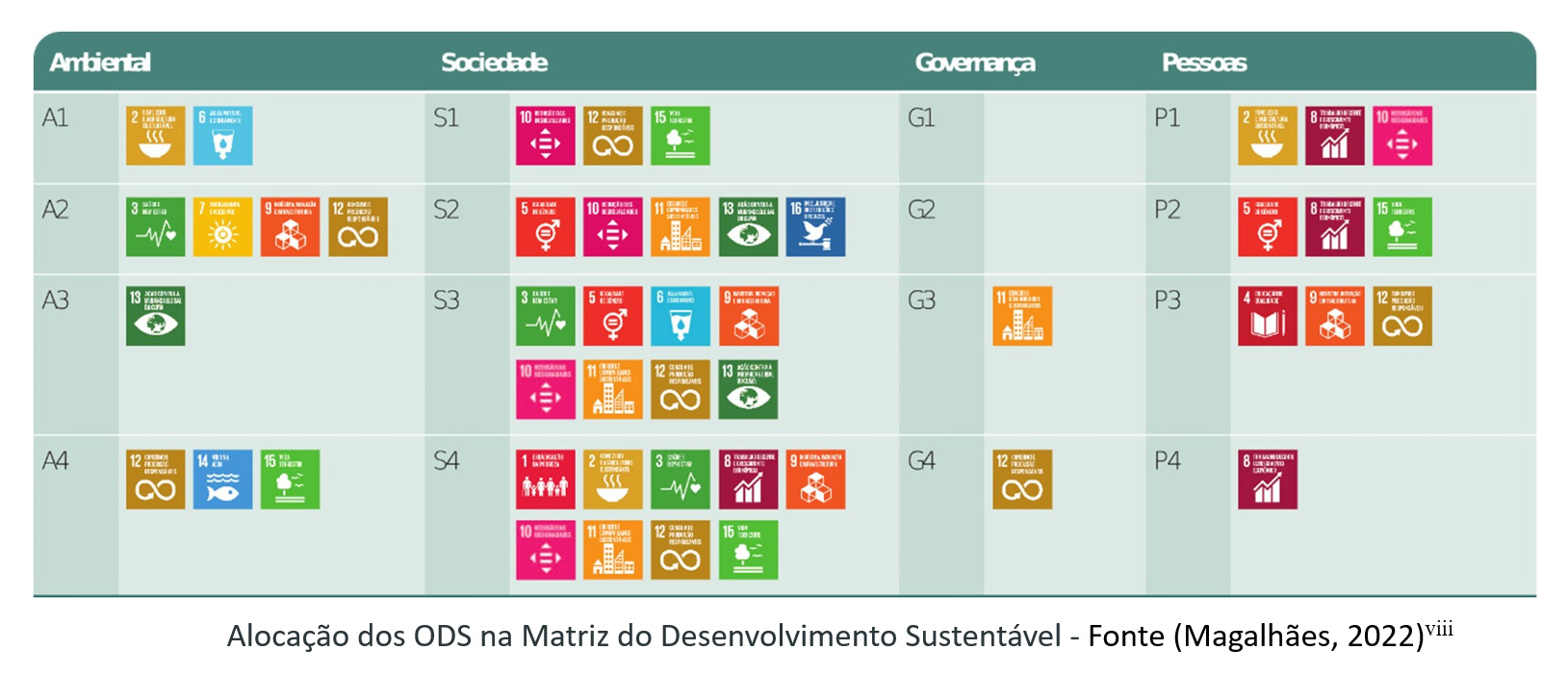
The Sustainable Development Matrix applicable to the public sector allows the allocation of the Sustainable Development Goals (SDGs) in their respective quadrants, so that it is possible to identify the performance of the Governance/Entity in its respective commitments.
(i) SAKAI, E.; ESG contra o greenwashing e socialwashing; OBSERVATÓRIO 3º SETOR. Mar 2022 available at https://observatorio3setor.org.br/ access on 29/10 (ii) MARSH, A. ; Social Washing Is Becoming Growing Headache for ESG Investors; Bloomberg News April 2020. Available at https://www.bloomberg.com/’ access on 29 out (iii) Pizzetti, Marta; Gatti, Lucia; Seele, Peter (2021). “Firms talk, suppliers walk: Analyzing the Locus of Greenwashing in the blame game and introducing ‘vicarious greenwashing'”. Journal of Business Ethics. 170: 21–38. doi:10.1007/s10551-019-04406-2. S2CID 214383794. (
Environmental Health Perspectives. 118 (6): a246–a252. doi:10.1289/ehp.118-a246. PMC 2898878. PMID 20515714.
(v) Ullman, Charlotte (2008). “Compte rendu de l’ouvrage ” L’entreprise verte ” d’Elisabeth Laville”. Netcom (in French) (22–3/4): 337–339. doi:10.4000/netcom.1764. vi MAGALHÃES, M.F.; Estratégias para o Desenvolvimento Sustentável ASG+P, GEN/ATLAS, Rio de Janeiro 2022 vii MAGALHÃES, M.F.; Estratégias para o Desenvolvimento Sustentável ASG+P, GEN/ATLAS, Rio de Janeiro 2022 viii MAGALHÃES, M.F.; Estratégias para o Desenvolvimento Sustentável ASG+P, GEN/ATLAS, Rio de Janeiro 2022
Related content

ATTENTION: Condominiums and Administrators must comply with the General Data Protection Law

Did you know that even MEIs, micro and small business owners must follow the General Data Protection Law?